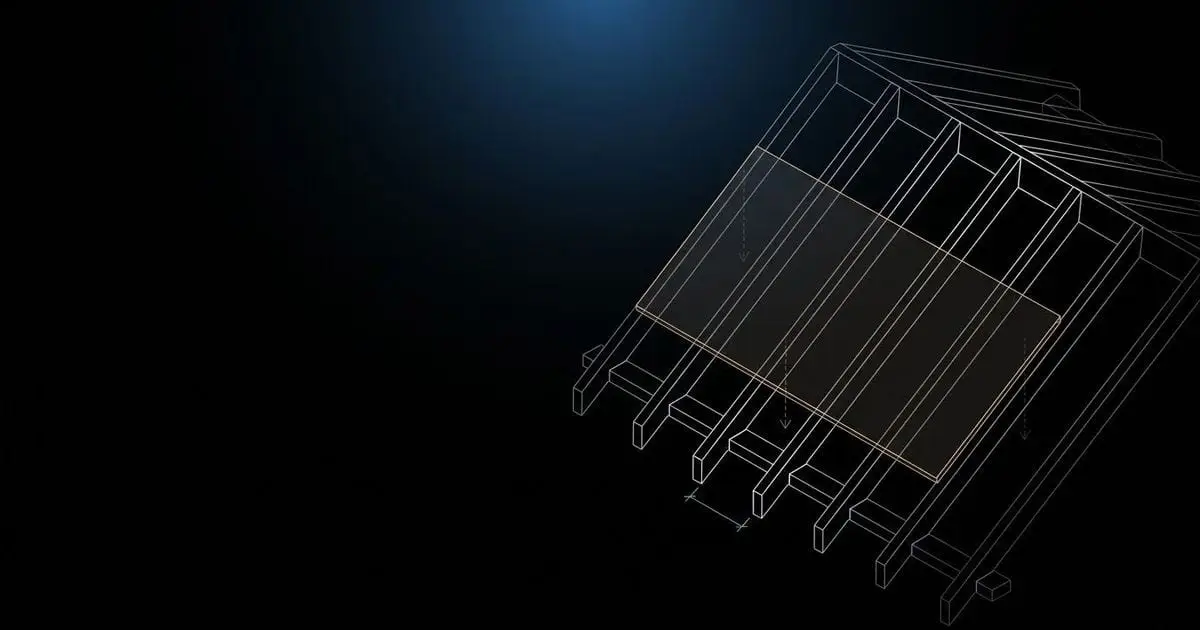
Roof sheathing, also called roof decking, is the solid layer of plywood or OSB nailed to the rafters. The shingles are only as good as the deck under them. Here is how to pick the right thickness and how many sheets to buy.
Plywood thickness by rafter spacing
| Rafter or truss spacing | Common choice | Heavier loads (snow, tile) | Notes |
|---|---|---|---|
| 12 in on center | 3/8 to 7/16 in | 1/2 in | Close spacing is rare in homes |
| 16 in on center | 7/16 in OSB or 15/32 in plywood | 1/2 to 5/8 in | Most common for older stick-framed roofs |
| 24 in on center | 15/32 to 1/2 in with H-clips | 19/32 to 5/8 in | Typical for modern trusses |
Actual thicknesses are slightly less than the nominal size: “1/2 inch” plywood is usually 15/32 inch, and “5/8 inch” is 19/32 inch.
Read the span rating, not just the thickness
Every structural panel has a stamp like 24/16 or 32/16.
- The first number is the maximum spacing of roof supports, in inches.
- The second number is the maximum floor joist spacing.
So a 24/16 panel is good for rafters up to 24 inches on center. Your rafter spacing must be equal to or less than the first number. Many codes also require edge support (H-clips or blocking) between rafters for some panels at 24 inches. Your local code and the panel stamp have the final word.
How many sheets do you need?
Sheets = roof area ÷ 32, plus about 10% for cuts at hips, valleys and rakes.
Example: a 40 × 30 ft house, 12 inch overhang, 6/12 pitch.
- Roof area: 42 × 32 × 1.118 = 1,503 sq ft
- Sheets: 1,503 ÷ 32 = 47.0
- With 10% waste: 47.0 × 1.10 = 51.7, so 52 sheets
Get your own area from the roof square footage calculator, then divide by 32.
| Roof area | Sheets (no waste) | With 10% waste |
|---|---|---|
| 1,000 sq ft | 31.3 | 35 |
| 1,500 sq ft | 46.9 | 52 |
| 2,000 sq ft | 62.5 | 69 |
| 2,500 sq ft | 78.1 | 86 |
Re-roofing: how many sheets will need replacing?
On a tear-off, roofers only replace the damaged decking they find, so contracts usually price it per sheet. If your house is older or had leaks, ask for the per-sheet price up front and budget for 5% to 15% of the deck.
Plywood or OSB?
Both are accepted by code when they carry the same span rating. OSB is usually cheaper and more uniform; plywood handles moisture a little better and dries out faster. The full comparison is in OSB vs plywood for roof sheathing. For code details, H-clips and heavy loads, see roof sheathing thickness, and for fastening, read roof sheathing nails and spacing.