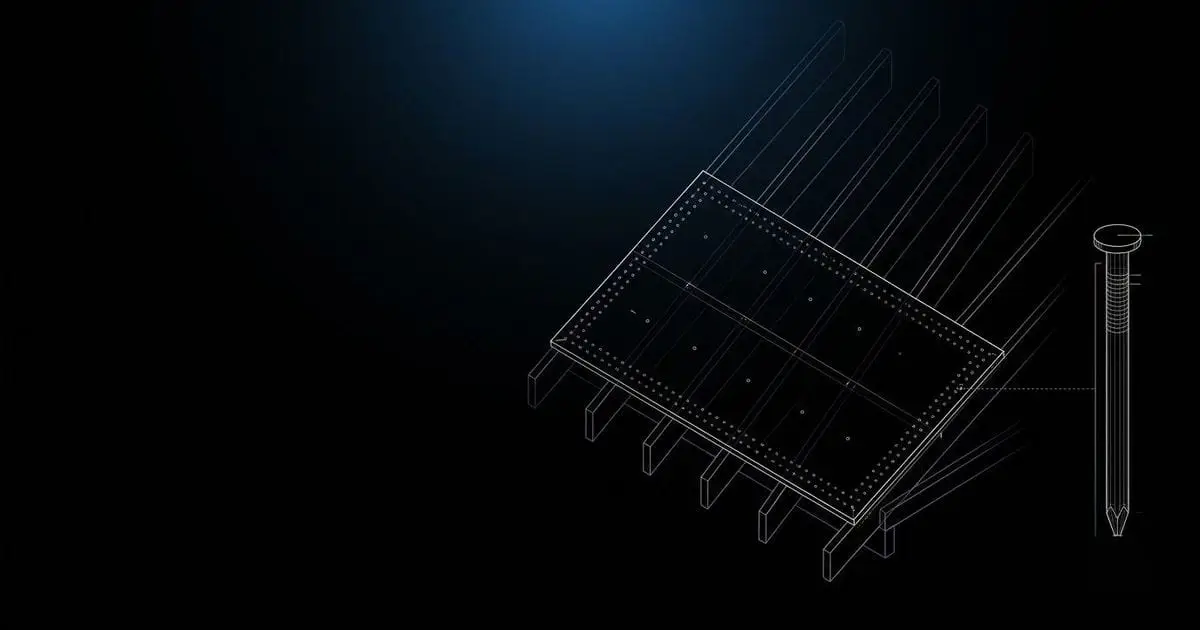
Most roof decks that fail in a storm do not break. They get pulled off because the nails were too few, too short or missed the rafters. The right nail and spacing is cheap insurance.
The standard nailing schedule
| Item | Typical requirement |
|---|---|
| Nail type | 8d common (2-1/2 in × 0.131 in) or 8d ring shank |
| Panel edges on a rafter | 6 in on center |
| Intermediate rafters (field) | 12 in on center |
| High-wind areas | Often ring shank, 6 in in the field, closer near edges |
| Distance from panel edge | At least 3/8 in |
This follows the common fastening schedule in the model residential code for panels up to 1 inch thick. Local codes in hurricane and high-wind zones are stricter, so check yours.
Nailing layout on one sheet
A 4 × 8 ft sheet is installed with the 8 ft side running across the rafters. On 16 inch spacing it lands on 7 rafters.
Rafter:  1     2     3     4     5     6     7
         |     |     |     |     |     |     |
 4 ft    •     ·     ·     ·     ·     ·     •    • = 6 in spacing (panel ends)
 edge    •     ·     ·     ·     ·     ·     •    · = 12 in spacing (field)
         •     ·     ·     ·     ·     ·     •
         •           ...                     •
Long edges between rafters are not nailed. They are supported by H-clips or blocking when required.
How many nails do you need?
Per sheet (4 × 8, 16 in rafter spacing):
- 2 panel ends × 9 nails at 6 inch spacing = 18
- 5 field rafters × 5 nails at 12 inch spacing = 25
- About 43 nails per sheet
On 24 inch spacing, each sheet lands on 5 rafters: 18 + 15 = about 33 nails per sheet.
Whole roof example: a 40 × 30 ft house with 12 inch overhangs at 6/12 has 1,503 sq ft of roof, about 52 sheets with waste. At 43 nails per sheet that is about 2,240 nails. 8d common nails run roughly 100 to 110 per pound, so plan on about 21 to 23 lb, or more in high-wind zones.
Get your roof area from the roof square footage calculator and divide by 32 for the sheet count.
Installation tips
- Hit the rafter. Snap chalk lines over rafter centers. Nails that miss (“shiners”) hold nothing and can rust through to the attic.
- Do not overdrive. Set nail guns so the head sits flush, not sunk into the panel face.
- Gap the panels about 1/8 inch, or as the panel maker requires.
- Stagger joints so panel ends do not line up on the same rafter.
- Edge of the roof: run sheathing to the fascia line so drip edge sits flat. Do not leave a long unsupported strip hanging past it.
Shingle nails are different
Shingles use roofing nails, usually 1-1/4 inch galvanized coil nails with a large head, 4 to 6 per shingle. Our calculator estimates about 2.5 lb of roofing nails per square in its materials list.
Before nailing, make sure the deck is the right thickness: see roof sheathing thickness and OSB vs plywood.