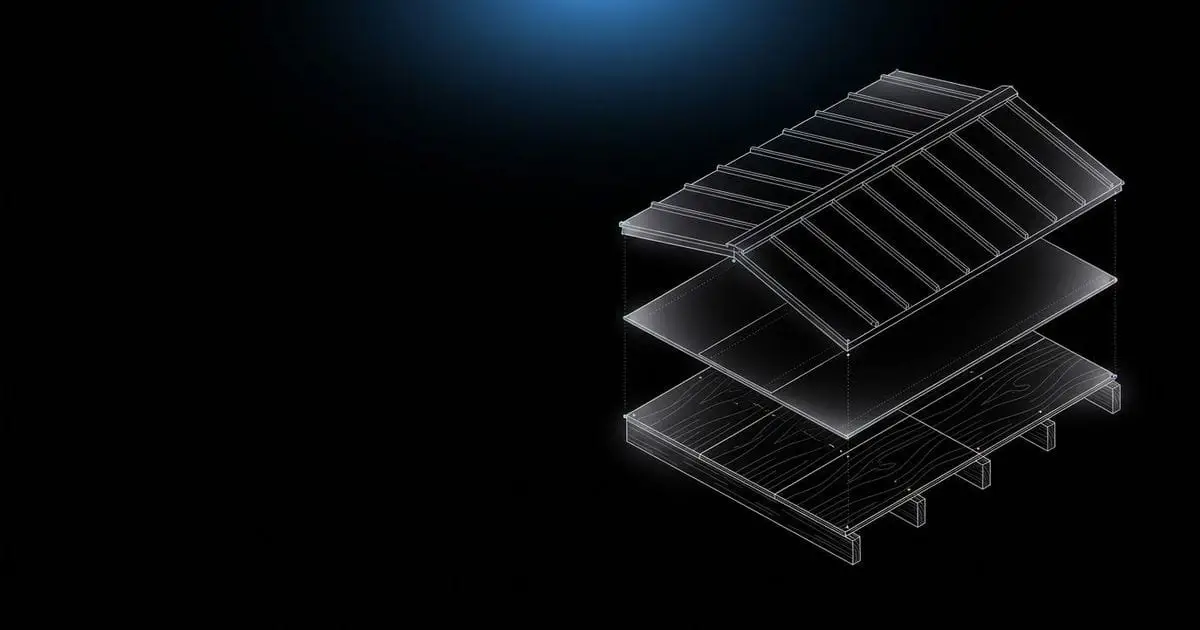
Underlayment is the layer between the roof deck and the shingles. It is your backup when wind-driven rain gets under the shingles, and it keeps the deck dry during installation. Here are the main types, side by side, and how to figure out how many rolls you need.
Underlayment types compared
| Type | Typical coverage per roll | Weight | Exposure tolerance | Cost level | Best for |
|---|---|---|---|---|---|
| #15 asphalt felt | ≈4 squares (400 sq ft) | Heavy | Days | Low | Budget jobs, under some tile |
| #30 asphalt felt | ≈2 squares (200 sq ft) | Heavier | Days | Low to mid | Steeper roofs, more tear resistance |
| Synthetic | often 10 squares (1,000 sq ft) | Light | Weeks to months (per product) | Mid | Most shingle and metal roofs |
| Peel-and-stick (self-adhered) | ≈2 squares (200 sq ft) | Heavy | Varies | High | Eaves, valleys, low slopes, high-wind zones |
Roll sizes vary by brand. Always confirm coverage on the label.
Asphalt felt
Felt paper is saturated with asphalt. It is cheap and familiar, but it tears more easily, can wrinkle when wet and gets slippery. #30 is thicker than #15 and holds up better while crews work.
Synthetic
Woven or spun polypropylene or polyethylene. It is far lighter per square, resists tearing, often has a walkable textured surface and comes in big rolls. Most shingle makers accept it, and it is the usual choice under metal roofs.
Peel-and-stick (ice and water barrier)
A rubberized asphalt membrane with a sticky back. It bonds to the deck and seals around nails. Building codes in cold climates require an ice barrier at the eaves where ice dams are common, typically from the edge to at least 24 inches inside the exterior wall.
Code basics worth knowing
- Asphalt shingles on pitches from 2/12 up to 4/12 need two layers of underlayment under the model residential code.
- In areas with a history of ice dams, an ice barrier is required at the eaves.
- The shingle manufacturer’s instructions can require specific underlayment for the warranty.
Local code can be stricter, so check with your building department.
How many rolls do you need?
Rolls needed = roof area × 1.10 (overlaps) ÷ roll coverage.
Example: a 40 × 30 ft house with 12 inch overhangs at 6/12 has 1,503 sq ft of roof, so about 1,653 sq ft with overlaps.
| Product | Coverage | Rolls |
|---|---|---|
| Synthetic | 1,000 sq ft | 2 |
| #15 felt | 400 sq ft | 5 |
| #30 felt | 200 sq ft | 9 |
Ice and water at the eaves: the two eaves are 42 ft each, 84 ft total. Two courses of a 3 ft wide membrane (to reach well inside the wall on this pitch) is 168 linear ft. At about 66 ft per roll, that is 3 rolls. Add more for valleys.
The roof calculator lists synthetic rolls in its materials list automatically.
Mistakes to avoid
- Leaving felt exposed for weeks. It degrades and wrinkles. Plan to dry-in and shingle quickly.
- Wrong lap direction. Each upper course must overlap the one below, like shingles, so water runs over the seams.
- Skipping ice barrier in cold climates. Ice dams push water uphill under shingles. Peel-and-stick at the eaves is the fix.
- Using standard felt under metal. Heat under metal can make asphalt felt stick and break down. See does a metal roof need underlayment.
For the deck beneath the underlayment, see roof sheathing thickness.