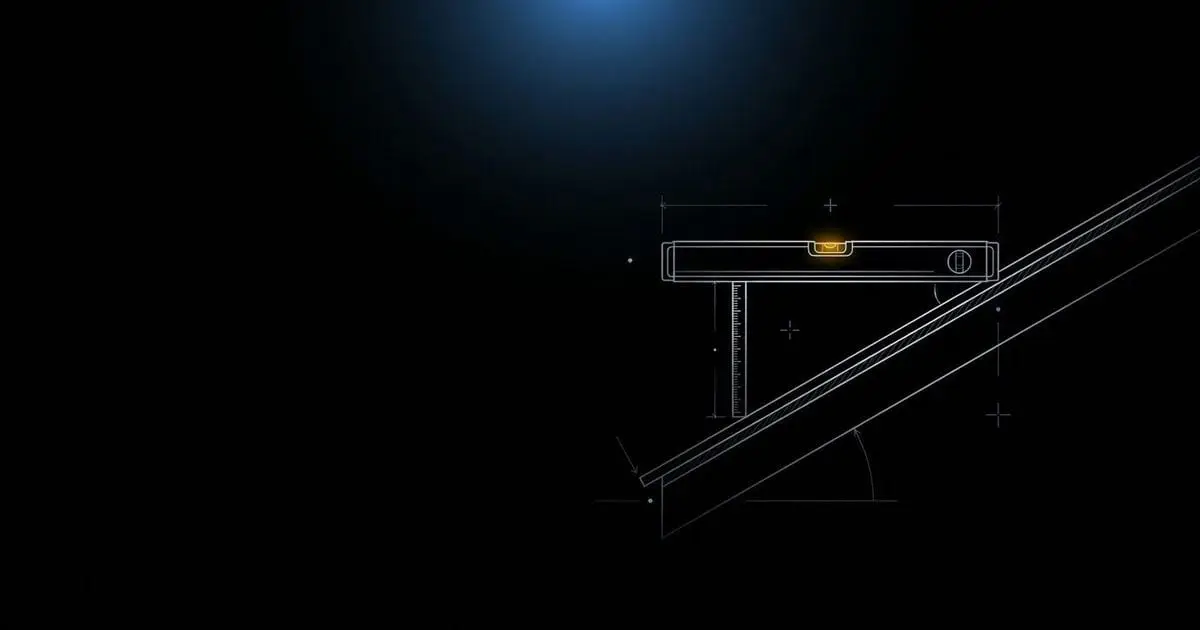
Pitch is the second most important number for your roof area, after length and width. Get it wrong by one step and a 2,000 sq ft roof can be off by 60 to 100 sq ft. Here are three ways to measure it safely, from the easiest to the most accurate.
Method 1: Level and tape from a ladder (most accurate)
You do not need to stand on the roof. Set a ladder at the gable end (the triangle-shaped wall), where the roof edge is exposed.
- Hold a level against the underside of the rake board or the roof edge so the bubble is centered (perfectly horizontal).
- Mark the level at 12 inches from the point where it touches the roof.
- At that 12 inch mark, measure straight up to the underside of the roof edge.
- That vertical distance is the rise. 5 inches = 5/12, 7 inches = 7/12.
If your level is shorter than 12 inches, measure at 6 inches and double the result.
Method 2: From the attic (safest)
Rafters in the attic follow the roof slope exactly.
- Find a straight rafter away from any sag.
- Hold the level against the bottom edge of the rafter, bubble centered.
- Measure 12 inches along the level, then measure straight up to the rafter.
- Read the rise the same way as above.
This is the best method for steep roofs and in bad weather. It does not work for vaulted ceilings without an attic.
Method 3: Phone app (fastest)
Most phones have a level or inclinometer in the built-in measure app, and free apps show degrees.
- Calibrate the app on a flat table.
- Lay the phone on a straight board resting across the roof surface, a rafter in the attic or the rake board.
- Read the angle in degrees.
- Convert it: rise = 12 × tan(angle), or type the degrees into the Pitch angle box of the roof calculator.
Quick conversion table
| Your reading | Pitch |
|---|---|
| 18 to 19° | 4/12 |
| 22 to 23° | 5/12 |
| 26 to 27° | 6/12 |
| 30° | 7/12 |
| 33 to 34° | 8/12 |
| 36 to 37° | 9/12 |
| 45° | 12/12 |
The full chart from 1/12 to 24/12, with slope percent, is in our roof pitch angle chart.
Mistakes that throw off your roof area
- Measuring on top of the shingles. Each course adds a small step. Use a board laid across several courses or measure on a rafter.
- Level not truly level. A level that is off by 1 degree turns a 6/12 into a reading of about 5.75/12 or 6.25/12.
- Measuring at a sag. Old roofs sag mid-span. Measure near a wall or the ridge.
- Assuming one pitch for the whole house. Porches, garages and additions often differ. Measure each and add each as its own section in the calculator.
- Mixing up pitch and degrees. “6” from a roofer is 6/12, about 26.6°, not 6 degrees.
What to do with the number
Enter the pitch with your length and width in the roof square footage calculator. It shows the true roof area, squares, bundles and materials. If your pitch looks unusual, compare it with the standard roof pitch for houses and sheds.